您正在查看: Surou 发布的文章

BOS节点部署,版本升级与测试

昨晚BOSCore已经完成了3秒LIB测试网启动,测试结果是1-3秒内达到不可逆,今天要再进行下中国社区部分的测试。

社区通知消息原文如下

国内社区 3s LIB版本升级演练

BOS 3s LIB测试网已经启动,为了让更多社区成员了解升级流程和特性,中国社区定于北京时间5月15日16:00开始演练,请大家提前做好准备。

此次版本升级的流程:
1.首先启动链时用boscore/bos:v2.0.3版本启动,各位注册bp,出块,模拟现在BOS的网络环境。
2.升级
   1)各个bp升级自己的节点版本至新版本,大多数bp升级好后进行下一步
   2)bp多签升级系统合约
   3)bp多签设置网络升级的块高度:target_number
  当lib到达设置的块高度时,共识变为pbft共识,3s可进lib,网络完成升级。

此外,邀请社区开发者对昨晚的lib-testnet做公开测试,发现问题者可以在github上提出issue,最终会根据大家提出的issue奖励BOS,最高奖励 1000 BOS 欢迎大家踊跃参与进来!!!可以加入:https://t.me/BOSTestnet

会议链接:
主题:BOS中国社区3s LIB版本升级演练
时间:五月 15, 2019 4:00 下午 北京,上海
加入 Zoom 会议
https://zoom.us/j/353729204

大家可以提前将自己的bp名字和公钥发给我,网络启动时帮大家创建好。

前段时间一直在忙,没有参与,只是默默围观,今天单独抽出时间参与下。
从技术方面来说,如果此方案稳定可行的话,对当前公司项目用户体验,可以有极大的提升。

环境准备

节点搭建对比EOS的来说,基本没差别,我们简单的记录下

准备个简单配置的测试机器

  • CPU: 4核
  • RAM: 8G
  • 地点: 香港阿里云

下载和编译代码

下载代码

git clone https://github.com/boscore/bos.git
git checkout -b v2.0.3

编译

cd bos/
git submodule update --init --recursive
./eosio_build.sh -s BOS

安装

sudo ./eosio_install.sh

配置节点

先运行下nodeos 初始化创建config.ini

配置config.ini

增加 p2p-peer-address

p2p-peer-address = 47.75.48.230:5016  #abp
p2p-peer-address = 47.75.107.217:2022
p2p-peer-address = 47.75.48.230:2018  #abp
p2p-peer-address = 3.1.39.190:10772 #blockedencom
p2p-peer-address = 47.52.101.176:9476 #itokenpocket
p2p-peer-address = 47.75.48.230:2018  #abp
p2p-peer-address = 47.75.48.230:5016  #abp
p2p-peer-address = 47.75.107.217:2022 # saylovetomom
p2p-peer-address = 15.164.99.58:9876 #starteosiobp

其余配置参考《从零开始,纯净机器上部署EOS测试网 (版本v1.4.1)》

创建genesis.json

{
  "initial_timestamp": "2019-05-15T00:30:00.000",
  "initial_key": "EOS6YFfrYZ3z7bNnzoZF4V2zJStudMJ4NJBBE1JXGzebVzMG9aLc7",
  "initial_configuration": {
    "max_block_net_usage": 1048576,
    "target_block_net_usage_pct": 1000,
    "max_transaction_net_usage": 524288,
    "base_per_transaction_net_usage": 12,
    "net_usage_leeway": 500,
    "context_free_discount_net_usage_num": 20,
    "context_free_discount_net_usage_den": 100,
    "max_block_cpu_usage": 200000,
    "target_block_cpu_usage_pct": 1000,
    "max_transaction_cpu_usage": 150000,
    "min_transaction_cpu_usage": 100,
    "max_transaction_lifetime": 3600,
    "deferred_trx_expiration_window": 600,
    "max_transaction_delay": 3888000,
    "max_inline_action_size": 4096,
    "max_inline_action_depth": 4,
    "max_authority_depth": 6
  }
}

模拟现在BOS的网络环境

此时运行nodeos --genesis-json 加上面genesis.json的路径,启动节点,此时能正常接收其他节点的出块。
注册BP节点,并被投票,成为出块节点

升级节点,更新共识协议

升级节点到最新版本

当前最新版本v3.0.0-rc3

git checkout -b v3.0.0-rc3

同上,编译,并安装,重新启动。

升级系统合约

新版本的系统合约:https://github.com/boscore/bos.contracts

cleos -u http://47.75.48.230:5015 set contract eosio ./eosio.system/ -p eosio -s -j -d > updatasystem.json
cleos -u http://47.75.48.230:5015 multisig propose_trx updatesystem bppermission1.json updatesystem.json bosstorebest
cleos -u http://47.75.48.230:5015 multisig approve bosstorebest updatesystem  '{"actor":"bosstorebest","permission":"active"}' -p bosstorebest
cleos -u http://47.75.48.230:5015 multisig exec bosstorebest updatesystem -p bosstorebest@active
cleos -u http://47.75.48.230:5015 multisig review bosstorebest updatesystem
cleos -u http://47.75.48.230:5015 get table eosio.msig bosstorebest approvals2

设置升级块高度提案

cleos -u http://47.75.48.230:5015   push action eosio setupgrade '{"up":{"target_block_num":21000}}' -p eosio  -s -j -d > setnum.json
cleos -u http://47.75.48.230:5015  multisig propose_trx setnum  bppermission1.json   setnum.json bosstorebest
cleos  -u http://47.75.48.230:5015  multisig approve  bosstorebest setnum  '{"actor":"bosstorebest","permission":"active"}'  -p  bosstorebest
cleos  -u http://47.75.48.230:5015  multisig exec bosstorebest setnum -p bosstorebest@active
查询设置的升级块高度
cleos -u http://47.75.48.230:5015 get table eosio eosio upgrade
{
  "rows": [{
      "target_block_num": 21000
    }
  ],
  "more": false
}

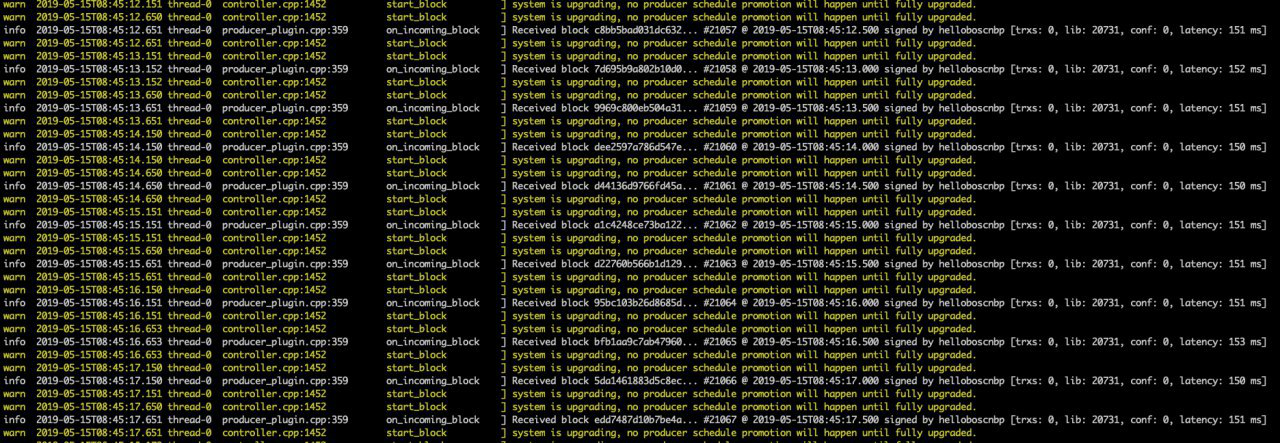
设置块高度时

达到设定的高度时输出以下log

表示升级成功了。

查询区块块信息

surou@DESKTOP-444S803:/mnt/c/Users/Surou$ cleos -u http://47.75.48.230:5015 get info
{
  "server_version": "82de16b9",
  "chain_id": "5c70c434cfd0ae8a2fde509fd452f8f64236ac120ba81631b239fb4bd1b1e2c3",
  "head_block_num": 29732,
  "last_irreversible_block_num": 29731,
  "last_irreversible_block_id": "000074234261f645187eae528b720577235d5bd306efb6a11906976c725e5583",
  "head_block_id": "00007424d2c9aecdf90f1e123c4ffbe4c30e14ce9428cffa18c70bda981de290",
  "head_block_time": "2019-05-15T10:02:49.000",
  "head_block_producer": "bospacificbp",
  "current_view": 0,
  "target_view": 1,
  "last_stable_checkpoint_block_num": 29701,
  "virtual_block_cpu_limit": 200000000,
  "virtual_block_net_limit": 1048576000,
  "block_cpu_limit": 199900,
  "block_net_limit": 1048576,
  "server_version_string": "v3.0.0-rc2-21-g82de16b98"
}

最新区块与不可逆块数,相差1块,此时不可逆确认时间间隔为0.5s

参考

常见问题

特别感谢 shiqi@eostore小妹妹补充的信息。

EOS源码分析之八区块及数据结构

eos源码分析之八区块及数据结构

做为EOS系列的最后一篇,把区块及相关的数据结构分析一下。虽然在前面的共识中分析过出块这部分,但对EOS的区块结构及一些细节并没有深入进去。

一、区块

EOS的区块设计不同的版本变化很大,这里以4.0的为模板分析,先看一下它的数据结构:

struct block_header
{
   block_timestamp_type             timestamp;
   account_name                     producer;//帐户标识符 13字节

   uint16_t                         confirmed = 1;  

   block_id_type                    previous;//前一块的HASH

   checksum256_type                 transaction_mroot; /// mroot of cycles_summary
   checksum256_type                 action_mroot; /// mroot of all delivered action receipts

   uint32_t                          schedule_version = 0;
   optional<producer_schedule_type>  new_producers;//新生产者
   extensions_type                   header_extensions;


   digest_type       digest()const;//摘要哈希
   block_id_type     id() const;   //自己的哈希
   uint32_t          block_num() const { return num_from_id(previous) + 1; }
   static uint32_t   num_from_id(const block_id_type& id);//ID是任意数字,区块号是从零长到现在的排序号 ID=HASH+n    
};

struct signed_block_header : public block_header
{
   signature_type    producer_signature;//生产者签名
};
struct signed_block : public signed_block_header {
   using signed_block_header::signed_block_header;
   signed_block() = default;
   signed_block( const signed_block_header& h ):signed_block_header(h){}

   vector<transaction_receipt>   transactions; /// new or generated transactions交易记录
   extensions_type               block_extensions;//扩展区
};
using signed_block_ptr = std::shared_ptr<signed_block>;//重定义一个新的数据类型,方便使用


这里感觉最大的不同是把原来的交易ID直接弄成了交易内容,这样有点简单粗暴的感觉,但是确实是容易理解一些。区块的生产在前面选举后分析过,这里不再赘述,看一下产生区块中对交易的处理。

二、交易和上链


正如所有的区块链一样,交易最终打包入区块,才是真正的区块成功能,也就是说,区块生产出来的目的不是单纯生产块,而要把交易数据打包进去,然后再保存到数据库,最终上链。

1、交易


transaction_trace_ptr push_transaction( const transaction_metadata_ptr& trx,
                                        fc::time_point deadline,
                                        bool implicit,
                                        uint32_t billed_cpu_time_us  )
{
   FC_ASSERT(deadline != fc::time_point(), "deadline cannot be uninitialized");

   transaction_trace_ptr trace;//交易检索
   try {
      transaction_context trx_context(self, trx->trx, trx->id); //交易管理控制
      trx_context.deadline = deadline;
      trx_context.billed_cpu_time_us = billed_cpu_time_us;
      trace = trx_context.trace;
      try {
         if( implicit ) {
            trx_context.init_for_implicit_trx();
         } else {
            trx_context.init_for_input_trx( trx->packed_trx.get_unprunable_size(),
                                            trx->packed_trx.get_prunable_size(),
                                            trx->trx.signatures.size() );
         }

         //检查权限集合
         if( !implicit && pending->_block_status == controller::block_status::incomplete ) {
            check_actor_list( trx_context.bill_to_accounts ); // Assumes bill_to_accounts is the set of actors authorizing the transaction
         }

        //延迟状态
         trx_context.delay = fc::seconds(trx->trx.delay_sec);

         //检查权限,这个前面分析过
         if( !self.skip_auth_check() && !implicit ) {
            authorization.check_authorization(
                    trx->trx.actions,
                    trx->recover_keys( chain_id ),
                    {},
                    trx_context.delay,
                    [](){}
                    /*std::bind(&transaction_context::add_cpu_usage_and_check_time, &trx_context,
                              std::placeholders::_1)*/,
                    false
            );
         }

         //执行上下文,其实就是执行tx中的action
         trx_context.exec();
         trx_context.finalize(); // Automatically rounds up network and CPU usage in trace and bills payers if successful

         //创建恢复点
         auto restore = make_block_restore_point();

         if (!implicit) {
            transaction_receipt::status_enum s = (trx_context.delay == fc::seconds(0))
                                                 ? transaction_receipt::executed
                                                 : transaction_receipt::delayed;
            //交易填充
            trace->receipt = push_receipt(trx->packed_trx, s, trx_context.billed_cpu_time_us, trace->net_usage);
            pending->_pending_block_state->trxs.emplace_back(trx);
         } else {
            transaction_receipt_header r;
            r.status = transaction_receipt::executed;
            r.cpu_usage_us = trx_context.billed_cpu_time_us;
            r.net_usage_words = trace->net_usage / 8;
            trace->receipt = r;
         }
         //填充ACTION
         fc::move_append(pending->_actions, move(trx_context.executed));

         // call the accept signal but only once for this transaction
         if (!trx->accepted) {
            emit( self.accepted_transaction, trx);
            trx->accepted = true;
         }

         emit(self.applied_transaction, trace);// 发送成功打包交易的消息

         trx_context.squash();//不敢肯定,是不是清理回退的数据
         restore.cancel();//取消恢复

         if (!implicit) {
            unapplied_transactions.erase( trx->signed_id );
         }
         return trace;
      } catch (const fc::exception& e) {
         trace->except = e;
         trace->except_ptr = std::current_exception();
      }

      if (!failure_is_subjective(*trace->except)) {
         unapplied_transactions.erase( trx->signed_id );
      }

      return trace;
   } FC_CAPTURE_AND_RETHROW((trace))
}


2、上链


在apply_block中:

void commit_block( bool add_to_fork_db ) {
   if( add_to_fork_db ) {
      pending->_pending_block_state->validated = true;
      auto new_bsp = fork_db.add( pending->_pending_block_state );
      emit( self.accepted_block_header, pending->_pending_block_state );
      head = fork_db.head();
      FC_ASSERT( new_bsp == head, "committed block did not become the new head in fork database" );

   }

//    ilog((fc::json::to_pretty_string(*pending->_pending_block_state->block)));
   emit( self.accepted_block, pending->_pending_block_state );

   if( !replaying ) {
      reversible_blocks.create<reversible_block_object>( [&]( auto& ubo ) {
         ubo.blocknum = pending->_pending_block_state->block_num;
         ubo.set_block( pending->_pending_block_state->block );
      });
   }

   pending->push();
   pending.reset();//恢复状态,可以再次出块

}


通过fork_db的操作把数据库存储起来,然后挂到链上,形成区块链。再广播出去,清除状态,重新准备出块。


三、相关的几个数据结构


有几个数据结构比较重要:multi_index,optional和scoped_exit。


1、访问数据库的multi_index


template<uint64_t TableName, typename T, typename... Indices>
class multi_index
{
   private:

      static_assert( sizeof...(Indices) <= 16, "multi_index only supports a maximum of 16 secondary indices" );

      constexpr static bool validate_table_name( uint64_t n ) {
         // Limit table names to 12 characters so that the last character (4 bits) can be used to distinguish between the secondary indices.
         return (n & 0x000000000000000FULL) == 0;
      }

      constexpr static size_t max_stack_buffer_size = 512;

      static_assert( validate_table_name(TableName), "multi_index does not support table names with a length greater than 12");

      uint64_t _code;
      uint64_t _scope;

      mutable uint64_t _next_primary_key;

      enum next_primary_key_tags : uint64_t {
         no_available_primary_key = static_cast<uint64_t>(-2), // Must be the smallest uint64_t value compared to all other tags
         unset_next_primary_key = static_cast<uint64_t>(-1)
      };

      struct item : public T
      {
         template<typename Constructor>
         item( const multi_index* idx, Constructor&& c )
         :\__idx(idx){
            c(\*this);
         }
......
      };

      struct item_ptr
      {
         item_ptr(std::unique_ptr<item>&& i, uint64_t pk, int32_t pitr)
         : \_item(std::move(i)), \_primary_key(pk), \_primary_itr(pitr) {}

......
      };

      mutable std::vector<item_ptr> _items_vector;

      template<uint64_t IndexName, typename Extractor, uint64_t Number, bool IsConst>
      struct index {
         public:
            typedef Extractor  secondary_extractor_type;
            typedef typename std::decay<decltype( Extractor()(nullptr) )>::type secondary_key_type;
......

            constexpr static uint64_t name()   { return index_table_name; }
            constexpr static uint64_t number() { return Number; }

            struct const_iterator : public std::iterator<std::bidirectional_iterator_tag, const T> {
               public:
                  friend bool operator == ( const const_iterator& a, const const_iterator& b ) {
                     return a.\_item == b.\_item;
                  }
                  friend bool operator != ( const const_iterator& a, const const_iterator& b ) {
                     return a.\_item != b.\_item;
                  }

                  const T& operator*()const { return *static_cast<const T*>(\_item); }
                  const T* operator->()const { return static_cast<const T*>(\_item); }

......

                     return *this;
                  }

                  const_iterator& operator--() {
                     using namespace \_multi_index_detail;

......

                     return \*this;
                  }

                  const_iterator():_item(nullptr){}
               private:
                  friend struct index;
                  const_iterator( const index* idx, const item* i = nullptr )
                  : _idx(idx), _item(i) {}

                  const index* _idx;
                  const item*  _item;
            }; /// struct multi_index::index::const_iterator

            typedef std::reverse_iterator<const_iterator> const_reverse_iterator;

            const_iterator cbegin()const {
               using namespace \_multi_index_detail;
               return lower_bound( secondary_key_traits<secondary_key_type>::lowest() );
            }
......

            const T& get( secondary_key_type&& secondary, const char* error_msg = "unable to find secondary key" )const {
               return get( secondary, error_msg );
            }

            // Gets the object with the smallest primary key in the case where the secondary key is not unique.
            const T& get( const secondary_key_type& secondary, const char* error_msg = "unable to find secondary key" )const {
               auto result = find( secondary );
               eosio_assert( result != cend(), error_msg );
               return *result;
            }

            const_iterator lower_bound( secondary_key_type&& secondary )const {
               return lower_bound( secondary );
            }
            const_iterator lower_bound( const secondary_key_type& secondary )const {
               using namespace \_multi_index_detail;
......

               return {this, &mi};
            }

            const_iterator upper_bound( secondary_key_type&& secondary )const {
               return upper_bound( secondary );
            }
            const_iterator upper_bound( const secondary_key_type& secondary )const {
......

               return {this, &mi};
            }

            const_iterator iterator_to( const T& obj ) {
......
               return {this, &objitem};
            }
......

            static auto extract_secondary_key(const T& obj) { return secondary_extractor_type()(obj); }

         private:
            friend class multi_index;

            index( typename std::conditional<IsConst, const multi_index*, multi_index*>::type midx )
            :_multidx(midx){}

            typename std::conditional<IsConst, const multi_index*, multi_index*>::type _multidx;
      }; /// struct multi_index::index

......
         const item* ptr = itm.get();
         auto pk   = itm->primary_key();
         auto pitr = itm->__primary_itr;

         _items_vector.emplace_back( std::move(itm), pk, pitr );

         return *ptr;
      } /// load_object_by_primary_iterator

   public:

      multi_index( uint64_t code, uint64_t scope )
      :_code(code),_scope(scope),_next_primary_key(unset_next_primary_key)
      {}

......

            _item = &_multidx->load_object_by_primary_iterator( prev_itr );
            return *this;
         }

         private:
            const_iterator( const multi_index* mi, const item* i = nullptr )
            :_multidx(mi),_item(i){}

            const multi_index* _multidx;
            const item*        _item;
            friend class multi_index;
      }; /// struct multi_index::const_iterator

      typedef std::reverse_iterator<const_iterator> const_reverse_iterator;

      const_iterator cbegin()const {
         return lower_bound(std::numeric_limits<uint64_t>::lowest());
      }
      const_iterator begin()const  { return cbegin(); }

.......

      void erase( const T& obj ) {
         using namespace \_multi_index_detail;

......

         hana::for_each( \_indices, [&]( auto& idx ) {
            typedef typename decltype(+hana::at_c<0>(idx))::type index_type;

            auto i = objitem.__iters[index_type::number()];
            if( i < 0 ) {
              typename index_type::secondary_key_type secondary;
              i = secondary_index_db_functions<typename index_type::secondary_key_type>::db_idx_find_primary( \_code, \_scope, index_type::name(), objitem.primary_key(),  secondary );
            }
            if( i >= 0 )
               secondary_index_db_functions<typename index_type::secondary_key_type>::db_idx_remove( i );
         });
      }

};


multi_index这个数据结构同样是仿照BOOST库中的boost::multi_index;估计EOS的开发人员觉得这个太重,自己搞了一个,当然,顺带实现很多自己独立的需求。需要说明的是WIKI上的说明是比较落后的,而且EOS开发团队也声明了,这个容器对象是不断演进的,所以说现在分析的可能已经是落后的了,但可能他们的大原则不会有剧烈的变动。


EOS为每个账户都预留了数据库空间(大小与代币持有量有关),账户可以建立多个数据表。智能合约无法直接操作存储在见证人硬盘中的数据表,需要使用multi_index作为中间工具(或者叫容器),每个multi_index实例都与一个特定账户的特定数据表进行交互(取决于实例化时的参数)。


这个多索引表有几个特点:类似ORM中的映射表,行为独立的对象,列为属性;有主键和非主键,排序时默认为升序,同样主键只能唯一并为uint64_t类型;支持自定函数做为索引,但返回值受限,即只能为支持的键类型;允许多索引排序,但是二级索引不大于16,前面的代码可以看到,同时不支持二级索引的直接构建;类似双向链表可以双向迭代。


它支持主要以下几种操作:


emplace:添加一个对象(row)到表中,返回一个新创建的主键迭代器。在这个过程中创建新对象,序列化写入表中,更新二级索引,付费。如果出现异常则直接抛出。


erase:这个就简单了,直接擦除。可以用迭代器也可以引用对象来删除。删除后返回之后的迭代器,并更新相关索引及费用。


modify:类似于数据库的UPDATE,这个比较麻烦,需要提供更新对象的迭代器,更新对象的引用,帐户(需要付费的)以及更新目标对象的函数(lambada),无返回值,在操作过程中主要是要对payer的属性进行判断,然后进行费用的计算和相关退费,完成后更新索引。


get:由主键查找对象,返回对象的引用,如果没找到,抛出异常。


find:根据主键查找已存在的对象。它的返回值是一个迭代器。如果没有查到返回一个end迭代器。


迭代器有点类似于STD标准库的迭代器,可以前后遍历,这里不再赘述。


2、类boost::optional的自定义容器


/**
 *  @brief provides stack-based nullable value similar to boost::optional
 *
 *  Simply including boost::optional adds 35,000 lines to each object file, using
 *  fc::optional adds less than 400.
 */
template<typename T>
class optional
{
  public:
    typedef T value_type;
    typedef typename std::aligned_storage<sizeof(T), alignof(T)>::type storage_type;

    optional():\_valid(false){}
    ~optional(){ reset(); }

    optional( optional& o )
    :_valid(false)
    {
      if( o._valid ) new (ptr()) T( *o );
      \_valid = o._valid;
    }

......

    template<typename U>
    optional( const optional<U>& o )
    :_valid(false)
    {
      if( o._valid ) new (ptr()) T( *o );
      \_valid = o._valid;
    }

    template<typename U>
    optional( optional<U>& o )
    :_valid(false)
    {
      if( o._valid )
      {
        new (ptr()) T( *o );
      }
      \_valid = o._valid;
    }

    template<typename U>
    optional( optional<U>&& o )
    :_valid(false)
    {
      if( o._valid ) new (ptr()) T( fc::move(*o) );
      \_valid = o._valid;
      o.reset();
    }

    ......

    optional& operator=( optional&& o )
    {
      if (this != &o)
      {
        if( \_valid && o._valid )
        {
          ref() = fc::move(*o);
          o.reset();
        } else if ( !\_valid && o._valid ) {
          \*this = fc::move(*o);
        } else if (\_valid) {
          reset();
        }
      }
      return \*this;
    }


    friend bool operator < ( const optional a, optional b )
    {
       if( a.valid() && b.valid() ) return \*a < \*b;
       return a.valid() < b.valid();
    }
......

    void     reset()
    {
        if( \_valid )
        {
            ref().~T(); // cal destructor
        }
        \_valid = false;
    }
  private:
    template<typename U> friend class optional;
    T&       ref()      { return \*ptr(); }
    const T& ref()const { return *ptr(); }
    T*       ptr()      { return reinterpret_cast<T*>(&\_value);  }
    const T* ptr()const { return reinterpret_cast<const T\*>(&\_value); }

    bool         _valid;
    storage_type _value;
};


这个其实不能称做一个容器,因为它一般只盛放一个数据结构,它的主要目的标题也很清楚,其实是老大们不愿意使用BOOST的相关代码,太多了,这个才几百行,小巧实用。


这个模板类的主要作用是封装一些数据结构,防止未初始化或者无意义的数据表达不清楚。比如一些返回值是NULL,有EOF,还有一些是string::npos等等,封装起来就是为了起一个标准的作用,其实你看这个类内部,并没有太多的真正意义的自己操作的数据,大多还是原生数据结构的使用。

3、范围控制的scoped_exit


template<typename Callback>
class scoped_exit {
   public:
      template<typename C>
      scoped_exit( C&& c ):callback( std::forward<C>(c) ){}

      scoped_exit( scoped_exit&& mv )
      :callback( std::move( mv.callback ) ),canceled(mv.canceled)
      {
         mv.canceled = true;
      }

      scoped_exit( const scoped_exit& ) = delete;
      scoped_exit& operator=( const scoped_exit& ) = delete;

      ~scoped_exit() {
         if (!canceled)
            try { callback(); } catch( ... ) {}
      }

      scoped_exit& operator = ( scoped_exit&& mv ) {
         if( this != &mv ) {
            ~scoped_exit();
            callback = std::move(mv.callback);
            canceled = mv.canceled;
            mv.canceled = true;
         }

         return \*this;
      }

      void cancel() { canceled = true; }

   private:
      Callback callback;
      bool canceled = false;
};

template<typename Callback>
scoped_exit<Callback> make_scoped_exit( Callback&& c ) {
   return scoped_exit<Callback>( std::forward<Callback>(c) );
}


这个类其实也得很有趣,如果对RAII比较了解的话,这个其实有一点变相的意思,在离开某个范围时,调用这个数据结构的析构函数,然后调用指定的回调函数来处理一些相关的事情,比如清理一些内存等等。


这里的模板构造函数用到了std::forward(c)完美转发,将左右值的匹配自动完成。一些小细节处理的相当不错。


其实EOS中的数据结构和编程方式还是有些复杂的,特别是其中一些使用了比较传统的宏模板自动创建的方法(在MFC中常见,但广受诟病),所以一些代码还是比较晦涩的,不建议也这样使用。

转载自:https://github.com/XChainLab/documentation/edit/master/eos/eos%E6%BA%90%E7%A0%81%E5%88%86%E6%9E%90%E4%B9%8B%E5%85%AB%E5%8C%BA%E5%9D%97%E5%8F%8A%E6%95%B0%E6%8D%AE%E7%BB%93%E6%9E%84.md

EOS源码分析之七钱包和帐户

eos源码分析之七钱包和帐户

一、EOS的钱包帐户

EOS的钱包其实主要就是管理密钥对,因为他不负责产生地址,也就是说,不会像以前的以太坊或者比特币,要通过密钥来产生钱包地址。它主要是提供对帐户的签名管理,也就是前面说的签名需要的密钥进行管理。
EOS使用是非UTXO机制,即帐户机制,这点和以太坊相同,但是他们又有不同之处,EOS为了使用安全方便,引入了权限和角色的功能。通过不同的帐户和私钥进行组合,可以达到创建不同的权限的帐户动作。举一个例子,你可以把你自己的帐户处理动作分配给任意的人,那么那个人就拥有了你的所有的帐户动作,但是它仍然是使用自己的密钥对来对你分配的动作进行签名。
要创建帐户,首先要创建钱包,因为创建帐户需要创建钱包时产生的密钥对。

//创建钱包
string wallet_name = "default";
auto createWallet = wallet->add_subcommand("create", localized("Create a new wallet locally"), false);
createWallet->add_option("-n,--name", wallet_name, localized("The name of the new wallet"), true);
createWallet->set_callback([&wallet_name] {
   // wait for keosd to come up
   try_port(uint16_t(std::stoi(parse_url(wallet_url).port)), 2000);

   const auto& v = call(wallet_url, wallet_create, wallet_name);
   std::cout << localized("Creating wallet: ${wallet_name}", ("wallet_name", wallet_name)) << std::endl;
   std::cout << localized("Save password to use in the future to unlock this wallet.") << std::endl;
   std::cout << localized("Without password imported keys will not be retrievable.") << std::endl;
   std::cout << fc::json::to_pretty_string(v) << std::endl;
});
//因为创建帐户需要创建钱包时产生的密钥对   
// create key
   create->add_subcommand("key", localized("Create a new keypair and print the public and private keys"))->set_callback( [](){
      auto pk    = private_key_type::generate();
      auto privs = string(pk);
      auto pubs  = string(pk.get_public_key());
      std::cout << localized("Private key: ${key}", ("key",  privs) ) << std::endl;
      std::cout << localized("Public key: ${key}", ("key", pubs ) ) << std::endl;
   });
//创建帐户
struct create_account_subcommand {
   string creator;
   string account_name;
   string owner_key_str;
   string active_key_str;
   string stake_net;
   string stake_cpu;
   uint32_t buy_ram_bytes_in_kbytes = 0;
   string buy_ram_eos;
   bool transfer;
   bool simple;

   create_account_subcommand(CLI::App* actionRoot, bool s) : simple(s) {
      auto createAccount = actionRoot->add_subcommand( (simple ? "account" : "newaccount"), localized("Create an account, buy ram, stake for bandwidth for the account"));
      createAccount->add_option("creator", creator, localized("The name of the account creating the new account"))->required();
      createAccount->add_option("name", account_name, localized("The name of the new account"))->required();
      //这里需要两个KEY
      createAccount->add_option("OwnerKey", owner_key_str, localized("The owner public key for the new account"))->required();
      createAccount->add_option("ActiveKey", active_key_str, localized("The active public key for the new account"));

......

      add_standard_transaction_options(createAccount);

      createAccount->set_callback([this] {
            if( !active_key_str.size() )
               active_key_str = owner_key_str;
            public_key_type owner_key, active_key;
            try {
               owner_key = public_key_type(owner_key_str);
            } EOS_RETHROW_EXCEPTIONS(public_key_type_exception, "Invalid owner public key: ${public_key}", ("public_key", owner_key_str));
            try {
               active_key = public_key_type(active_key_str);
            } EOS_RETHROW_EXCEPTIONS(public_key_type_exception, "Invalid active public key: ${public_key}", ("public_key", active_key_str));
            auto create = create_newaccount(creator, account_name, owner_key, active_key);//创建一个帐户
.......
      });
   }
};
chain::action create_newaccount(const name& creator, const name& newaccount, public_key_type owner, public_key_type active) {
   return action {
      tx_permission.empty() ? vector<chain::permission_level>{{creator,config::active_name}} : get_account_permissions(tx_permission),
      eosio::chain::newaccount{//调用帐户创建
         .creator      = creator,
         .name         = newaccount,
         .owner        = eosio::chain::authority{1, {{owner, 1}}, {}},
         .active       = eosio::chain::authority{1, {{active, 1}}, {}}
      }
   };
}


整体的步骤来说就是创建钱包,创建密钥,导入密钥到钱包,由密钥来创建帐户。看代码中还有一个直接在钱包中创建密钥的命令。


旧的帐户的管理在插件account_history_plugin中。它提供了一个接口插件account_history_api_plugin用来更方便的管理帐户的历史记录。同样,在历史记录的类管理里中,使用了account_history_plugin_impl类来真正提供历史记录的控制。


但是在新的版本中,用history_plugin替代了它,相应的接口也替换成了history_api_plugin.这里面主要涉及到了以下几个类(排除api接口类):history_plugin_impl,这个类是真正的操作数据的类,所有的关于历史记录的动作,最终都要落在这个类中。history_plugin是插件增加的实体类,是调用history_plugin_impl的入口点。read_only类是真正处理数据的类。


这里看一个帐户的交易记录读取:

read_only::get_transaction_result read_only::get_transaction( const read_only::get_transaction_params& p )const {
   auto& chain = history->chain_plug->chain();//获得当前指定的Controller

   get_transaction_result result;

   result.id = p.id;
   result.last_irreversible_block = chain.last_irreversible_block_num();

   const auto& db = chain.db();//获得当前数据库的句柄

   //得到并处理multiindex的结果
   const auto& idx = db.get_index<action_history_index, by_trx_id>();
   auto itr = idx.lower_bound( boost::make_tuple(p.id) );
   if( itr == idx.end() ) {
      return result;
   }
   result.id         = itr->trx_id;
   result.block_num  = itr->block_num;
   result.block_time = itr->block_time;

   if( fc::variant(result.id).as_string().substr(0,8) != fc::variant(p.id).as_string().substr(0,8) )
      return result;

   //处理事务action内容
   while( itr != idx.end() && itr->trx_id == result.id ) {

     fc::datastream<const char*> ds( itr->packed_action_trace.data(), itr->packed_action_trace.size() );
     action_trace t;
     fc::raw::unpack( ds, t );
     result.traces.emplace_back( chain.to_variant_with_abi(t) );

     ++itr;
   }

   //处理块
   auto blk = chain.fetch_block_by_number( result.block_num );
   if( blk == nullptr ) { // still in pending
       auto blk_state = chain.pending_block_state();
       if( blk_state != nullptr ) {
           blk = blk_state->block;
       }
   }
   //得到交易内容
   if( blk != nullptr ) {
       for (const auto &receipt: blk->transactions) {
           if (receipt.trx.contains<packed_transaction>()) {
               auto &pt = receipt.trx.get<packed_transaction>();
               auto mtrx = transaction_metadata(pt);
               if (mtrx.id == result.id) {
                   fc::mutable_variant_object r("receipt", receipt);
                   r("trx", chain.to_variant_with_abi(mtrx.trx));
                   result.trx = move(r);
                   break;
               }
           } else {
               auto &id = receipt.trx.get<transaction_id_type>();
               if (id == result.id) {
                   fc::mutable_variant_object r("receipt", receipt);
                   result.trx = move(r);
                   break;
               }
           }
       }
   }

   return result;
}

//chainbase.hpp

template<typename MultiIndexType>
const generic_index<MultiIndexType>& get_index()const
{
   CHAINBASE_REQUIRE_READ_LOCK("get_index", typename MultiIndexType::value_type);
   typedef generic_index<MultiIndexType> index_type;
   typedef index_type*                   index_type_ptr;
   assert( \_index_map.size() > index_type::value_type::type_id );
   assert( \_index_map[index_type::value_type::type_id] );
   return *index_type_ptr( \_index_map[index_type::value_type::type_id]->get() );//返回一个multiindex的容器指针
}


这个函数会在history_api_plugin.cpp中由:

void history_api_plugin::plugin_startup() {
   ilog( "starting history_api_plugin" );
   auto ro_api = app().get_plugin<history_plugin>().get_read_only_api();
   //auto rw_api = app().get_plugin<history_plugin>().get_read_write_api();

   app().get_plugin<http_plugin>().add_api({
//      CHAIN_RO_CALL(get_transaction),
      CHAIN_RO_CALL(get_actions),
      CHAIN_RO_CALL(get_transaction),
      CHAIN_RO_CALL(get_key_accounts),
      CHAIN_RO_CALL(get_controlled_accounts)
   });
}


提供HTTP的调用,并封装成JSON格式回传给相关调用方。

二、帐户的权限和角色


在前边创建帐户时提到了owner 和 active,它们的权限分别有一个值为1的阈值。owner 和 active 所绑定的 公钥 , 则分别有一个值为1的权重。阈值和权重是什么呢?


阈值是指操作的最小权限,而权重指权限量。简单的说明一下,比如打开保险柜的阈值是3,然后有三个角色权重:1,2,3.则3权重的可以自己直接打开。2和1权重的需要向其它两个角色申请,当权重总和>=3时,才可以打开。


owner是自己的根本权限,可以用来授权给别人的权限。而active是被授予的相关的权限。网上举得例子比较好理解:


owner这个权限比作一扇门,打开这扇门需要一把正确的钥匙。 而 owner 所绑定的那个公钥 对应的那把私钥 就是正确的钥匙。那么二者到底有什么具体的关系和内容呢?


owner:啥都能干,还可以做冷备份。


active:除了不能修改owner之外的所有权限。其它所有的权限都是基于active产生出来的。


帐户的权限在EOS中功能相对来说是比较全的。在EOS中分为单签名帐户和多签名帐户。

1、单签名帐户


因此单签名账户就是权限的阈值和钥匙的权重都为1的一种账户类型。使用某个权限,只需要一把对应的私钥就行了.

struct newaccount {
   account_name                     creator;
   account_name                     name;
   authority                        owner;
   authority                        active;
......
};


单权限


单签名其实好理解,其实就是一句话,自己的事情自己干,当然,如果你授权给了别人,别人也可以干,不过不用二者合作,一个即可。

2、多签名帐户


多签名帐户其实就是一个权限绑定了多个帐户或者公钥。要想使用一个权限得需要大于1个以上的签名了。

多签名帐户


还是举一个例子,比如有一个权限可以从帐户转走一笔钱,转钱的权限阈值设定为3,有三个角色bob,alice,joe,他们对应的权重为2,2,3.那么joe自己就可以直接操作转钱,而bob,alice由于权重不足,只能二者互相合作或者去向joe申请合作。


它对应到EOS的区块链上,其实就是对帐户的授权,比如某个智能合约需要权限才能操作,那么它会在执行前检查当前帐户的权限,如果不足,则直接退出。否则,完成。

3、密钥的恢复


在EOS中,有一个比较重要的特点就是被盗窃的密钥可以恢复,不会像比特币那样,密钥丢失后所有的一切都永远的消失在区块链中。不过恢复也不是没有条件的:


首先,使用任何30天内的owner权限的密钥和指定的合作伙伴才能恢复。


其次,合作伙伴不参成任何日常交易。合作伙伴其实就是指你的关联帐户。


最后,在恢复的过程中,也可以设置一些类似QQ的恢复机制中的问题机制。

三、签名的验证


既然前面提到了签名需要验证,分析一下验证的过程,从push_transcations中对比一下:

void apply_context::schedule_deferred_transaction( const uint128_t& sender_id, account_name payer, transaction&& trx, bool replace_existing ) {
......

   if( !control.skip_auth_check() && !privileged ) { // Do not need to check authorization if replayng irreversible block or if contract is privileged
      if( payer != receiver ) {
         require_authorization(payer); /// uses payer's storage
      }

      // if a contract is deferring only actions to itself then there is no need
      // to check permissions, it could have done everything anyway.
      bool check_auth = false;
      for( const auto& act : trx.actions ) {
         if( act.account != receiver ) {
            check_auth = true;
            break;
         }
      }
      if( check_auth ) {
         control.get_authorization_manager()
                .check_authorization( trx.actions,
                                      {},
                                      {{receiver, config::eosio_code_name}},
                                      delay,
                                      std::bind(&transaction_context::checktime, &this->trx_context),
                                      false
                                    );
      }
   }

   uint32_t trx_size = 0;
   auto& d = control.db();
......

   trx_context.add_ram_usage( payer, (config::billable_size_v<generated_transaction_object> + trx_size) );
}

void apply_context::require_authorization(const account_name& account,
                                          const permission_name& permission) {
  for( uint32_t i=0; i < act.authorization.size(); i++ )
     if( act.authorization[i].actor == account ) {
        if( act.authorization[i].permission == permission ) {
           used_authorizations[i] = true;
           return;
        }
     }
  EOS_ASSERT( false, missing_auth_exception, "missing authority of ${account}/${permission}",
              ("account",account)("permission",permission) );
}

void
authorization_manager::check_authorization( const vector<action>&                actions,
                                            const flat_set<public_key_type>&     provided_keys,
                                            const flat_set<permission_level>&    provided_permissions,
                                            fc::microseconds                     provided_delay,
                                            const std::function<void()>&         \_checktime,
                                            bool                                 allow_unused_keys
                                          )const
{
   const auto& checktime = ( static_cast<bool>(\_checktime) ? \_checktime : \_noop_checktime );

   auto delay_max_limit = fc::seconds( \_control.get_global_properties().configuration.max_transaction_delay );

   auto effective_provided_delay =  (provided_delay >= delay_max_limit) ? fc::microseconds::maximum() : provided_delay;

   auto checker = make_auth_checker( [&](const permission_level& p){ return get_permission(p).auth; },
                                     \_control.get_global_properties().configuration.max_authority_depth,
                                     provided_keys,
                                     provided_permissions,
                                     effective_provided_delay,
                                     checktime
                                   );

   map<permission_level, fc::microseconds> permissions_to_satisfy;

   for( const auto& act : actions ) {
      bool special_case = false;
      fc::microseconds delay = effective_provided_delay;

      if( act.account == config::system_account_name ) {
         special_case = true;

         if( act.name == updateauth::get_name() ) {
            check_updateauth_authorization( act.data_as<updateauth>(), act.authorization );
         } else if( act.name == deleteauth::get_name() ) {
            check_deleteauth_authorization( act.data_as<deleteauth>(), act.authorization );
         } else if( act.name == linkauth::get_name() ) {
            check_linkauth_authorization( act.data_as<linkauth>(), act.authorization );
         } else if( act.name == unlinkauth::get_name() ) {
            check_unlinkauth_authorization( act.data_as<unlinkauth>(), act.authorization );
         } else if( act.name ==  canceldelay::get_name() ) {
            delay = std::max( delay, check_canceldelay_authorization(act.data_as<canceldelay>(), act.authorization) );
         } else {
            special_case = false;
         }
      }

      for( const auto& declared_auth : act.authorization ) {

         checktime();

         if( !special_case ) {
            auto min_permission_name = lookup_minimum_permission(declared_auth.actor, act.account, act.name);
            if( min_permission_name ) { // since special cases were already handled, it should only be false if the permission is eosio.any
               const auto& min_permission = get_permission({declared_auth.actor, \*min_permission_name});
               EOS_ASSERT( get_permission(declared_auth).satisfies( min_permission,
                                                                    \_db.get_index<permission_index>().indices() ),
                           irrelevant_auth_exception,
                           "action declares irrelevant authority '${auth}'; minimum authority is ${min}",
                           ("auth", declared_auth)("min", permission_level{min_permission.owner, min_permission.name}) );
            }
         }

         auto res = permissions_to_satisfy.emplace( declared_auth, delay );
         if( !res.second && res.first->second > delay) { // if the declared_auth was already in the map and with a higher delay
            res.first->second = delay;
         }
      }
   }

   // Now verify that all the declared authorizations are satisfied:

   // Although this can be made parallel (especially for input transactions) with the optimistic assumption that the
   // CPU limit is not reached, because of the CPU limit the protocol must officially specify a sequential algorithm
   // for checking the set of declared authorizations.
   // The permission_levels are traversed in ascending order, which is:
   // ascending order of the actor name with ties broken by ascending order of the permission name.
   for( const auto& p : permissions_to_satisfy ) {
      checktime(); // TODO: this should eventually move into authority_checker instead
      EOS_ASSERT( checker.satisfied( p.first, p.second ), unsatisfied_authorization,
                  "transaction declares authority '${auth}', "
                  "but does not have signatures for it under a provided delay of ${provided_delay} ms",
                  ("auth", p.first)("provided_delay", provided_delay.count()/1000)
                  ("delay_max_limit_ms", delay_max_limit.count()/1000)
                );

   }

   if( !allow_unused_keys ) {
      EOS_ASSERT( checker.all_keys_used(), tx_irrelevant_sig,
                  "transaction bears irrelevant signatures from these keys: ${keys}",
                  ("keys", checker.unused_keys()) );
   }
}


不过上面的英文注释很搞笑,说其实不必检查,这也是有谁没谁的了。在controller.cpp中push_transcation中也有类似的调用,可以对比分析。这样的情况下基本上帐户和钱包也就分析的差不多了。

转载自:https://github.com/XChainLab/documentation/edit/master/eos/eos%E6%BA%90%E7%A0%81%E5%88%86%E6%9E%90%E4%B9%8B%E4%B8%83%E9%92%B1%E5%8C%85%E5%92%8C%E5%B8%90%E6%88%B7.md

EOS源码分析之六共识

eos源码分析之六共识

一、EOS使用的共识

EOS使用的是与传统的共识方法不同的DPOS共识机制,而且在最新的版本中已经更改为了BFT-DPOS机制,在网上看到BM说他又找到了一种更新的共识机制,可以解决被超级节点控制的问题,不知道最终会是什么样子,在比特币和以太坊都使用POW的共识的前提下,EOS使用DPOS机制,可以说是解决高并发的一个比较好的方法。但是,DPOS机制很容易由于节点太少被攻击,事实上也是如此。那么什么是DPOS呢?EOS是怎么使用其进行块之间的共识的呢?


提到dpos,就不得不提到pos,PoS全称Proof of Stake,意为权益证明。说得直白一些就是谁存款多,存款时间长,谁就有权出块(记帐)。这个解决了POW一个痛点,即它不用挖矿,所以也不用耗费老多的电能。但是这这个算法有个致命问题,资本决定了一切,所以很容易被有钱人垄断。


DPOS比POS多了一个D,它的意义是授权,委托。二者的区别是,DPOS需要POS的持有者来通过选举代表,由代表实现出块。而在EOS中则有21个出块者(BP,BlcokProducer),或者叫超级节点。还有101个备份节点。当21个BP的15个确认交易后,交易即不可逆转。

二、共识的过程


1、初始化的共识


EOS初始启动是外在选举的21个超级节点,所以不涉及代码部分。但是一旦启动后会开始新的节点选举,选举成功后,将进行BFT-DPOS共识。


2、选举


主要的代码在contracts/social和eosio.system/voting.cpp中。在cleos的main.cpp中会发现几个数据结构体和相关的应用:


 auto registerProducer = register_producer_subcommand(system);
 auto unregisterProducer = unregister_producer_subcommand(system);

 auto voteProducer = system->add_subcommand("voteproducer", localized("Vote for a producer"));
 voteProducer->require_subcommand();
 auto voteProxy = vote_producer_proxy_subcommand(voteProducer);
 auto voteProducers = vote_producers_subcommand(voteProducer);
 auto approveProducer = approve_producer_subcommand(voteProducer);
 auto unapproveProducer = unapprove_producer_subcommand(voteProducer);

 auto listProducers = list_producers_subcommand(system);

 auto delegateBandWidth = delegate_bandwidth_subcommand(system);
 auto undelegateBandWidth = undelegate_bandwidth_subcommand(system);
 auto listBandWidth = list_bw_subcommand(system);


这些代码会驱动程序在启动后进行相应的动作。选举在EOS中其实也分成两类,即每人独自发起选举,也可以通过代理人代替自己选举,但结果就是本人就无法再投票了。相应的代码如下:

 /**
 *  @pre producers must be sorted from lowest to highest and must be registered and active
 *  @pre if proxy is set then no producers can be voted for
 *  @pre if proxy is set then proxy account must exist and be registered as a proxy
 *  @pre every listed producer or proxy must have been previously registered
 *  @pre voter must authorize this action
 *  @pre voter must have previously staked some EOS for voting
 *  @pre voter->staked must be up to date
 *
 *  @post every producer previously voted for will have vote reduced by previous vote weight
 *  @post every producer newly voted for will have vote increased by new vote amount
 *  @post prior proxy will proxied_vote_weight decremented by previous vote weight
 *  @post new proxy will proxied_vote_weight incremented by new vote weight
 *
 *  If voting for a proxy, the producer votes will not change until the proxy updates their own vote.
 */
 //上面的介绍过程挺详细
 void system_contract::voteproducer( const account_name voter_name, const account_name proxy, const std::vector<account_name>& producers ) {
    require_auth( voter_name );//验证资格
    update_votes( voter_name, proxy, producers, true );
 }
 void system_contract::update_votes( const account_name voter_name, const account_name proxy, const std::vector<account_name>& producers, bool voting ) {
   //validate input
   if ( proxy ) {//判断是否为代理
      eosio_assert( producers.size() == 0, "cannot vote for producers and proxy at same time" );
      eosio_assert( voter_name != proxy, "cannot proxy to self" );
      require_recipient( proxy );//添加代理帐户
   } else {
      eosio_assert( producers.size() <= 30, "attempt to vote for too many producers" );
      for( size_t i = 1; i < producers.size(); ++i ) { //验证英文注释中的排序
         eosio_assert( producers[i-1] < producers[i], "producer votes must be unique and sorted" );
      }
   }

   //验证资格
   auto voter = \_voters.find(voter_name);
   eosio_assert( voter \!= \_voters.end(), "user must stake before they can vote" ); /// staking creates voter object
   eosio_assert( !proxy || !voter->is_proxy, "account registered as a proxy is not allowed to use a proxy" );

   /*
    * The first time someone votes we calculate and set last_vote_weight, since they cannot unstake until
    * after total_activated_stake hits threshold, we can use last_vote_weight to determine that this is
    * their first vote and should consider their stake activated.
    \*/
  //计算权重,用来控制其抵押股权状态,并确定其是否为第一次投票
   if( voter->last_vote_weight <= 0.0 ) {
    \_gstate.total_activated_stake += voter->staked;
      if( \_gstate.total_activated_stake >= min_activated_stake ) {
         \_gstate.thresh_activated_stake_time = current_time();
      }
   }

   //计算权重
   auto new_vote_weight = stake2vote( voter->staked );
   if( voter->is_proxy ) {//是否代理
      new_vote_weight += voter->proxied_vote_weight;
   }

  //处理投票
   boost::container::flat_map<account_name, pair<double, bool /*new*/> > producer_deltas;
   if ( voter->last_vote_weight > 0 ) {
      if( voter->proxy ) {
         auto old_proxy = \_voters.find( voter->proxy );
         eosio_assert( old_proxy != \_voters.end(), "old proxy not found" ); //data corruption
         \_voters.modify( old_proxy, 0, [&]( auto& vp ) {//投票后减去相应权重,对应英文注释
               vp.proxied_vote_weight -= voter->last_vote_weight;
            });
         propagate_weight_change( *old_proxy ); //继续更新相关权重
      } else {
        //非代理直接操作,一票三十投
         for( const auto& p : voter->producers ) {
            auto& d = producer_deltas[p];
            d.first -= voter->last_vote_weight;
            d.second = false;
         }
      }
   }

   //处理得票
   if( proxy ) {//处理代理
      auto new_proxy = \_voters.find( proxy );
      eosio_assert( new_proxy != \_voters.end(), "invalid proxy specified" ); //if ( !voting ) { data corruption } else { wrong vote }
      eosio_assert( !voting || new_proxy->is_proxy, "proxy not found" );
      if ( new_vote_weight >= 0 ) {
         \_voters.modify( new_proxy, 0, [&]( auto& vp ) {
               vp.proxied_vote_weight += new_vote_weight;
            });
         propagate_weight_change( *new_proxy );
      }
   } else {
      if( new_vote_weight >= 0 ) {
         for( const auto& p : producers ) {
            auto& d = producer_deltas[p];
            d.first += new_vote_weight;
            d.second = true;
         }
      }
   }

  //  投票资格验证
   for( const auto& pd : producer_deltas ) {
      auto pitr = \_producers.find( pd.first );
      if( pitr != \_producers.end() ) {
         eosio_assert( !voting || pitr->active() || !pd.second.second /* not from new set */, "producer is not currently registered" );
         \_producers.modify( pitr, 0, [&]( auto& p ) {
            p.total_votes += pd.second.first;
            if ( p.total_votes < 0 ) { // floating point arithmetics can give small negative numbers
               p.total_votes = 0;
            }
            \_gstate.total_producer_vote_weight += pd.second.first;
            //eosio_assert( p.total_votes >= 0, "something bad happened" );
         });
      } else {
         eosio_assert( !pd.second.second /* not from new set */, "producer is not registered" ); //data corruption
      }
   }

  //更新选举状态
   \_voters.modify( voter, 0, [&]( auto& av ) {
      av.last_vote_weight = new_vote_weight;
      av.producers = producers;
      av.proxy     = proxy;
   });
}


在前面的投票过程中发现,其实要想选举和成为出块者,都需要先行去注册,在最初的Main函数里也提到相应的子命令,那么看一下对应的代码:

 /**
  *  This method will create a producer_config and producer_info object for 'producer'
  *
  *  @pre producer is not already registered
  *  @pre producer to register is an account
  *  @pre authority of producer to register
  *
  */
 void system_contract::regproducer( const account_name producer, const eosio::public_key& producer_key, const std::string& url, uint16_t location ) {
    eosio_assert( url.size() < 512, "url too long" );
    eosio_assert( producer_key != eosio::public_key(), "public key should not be the default value" );
    require_auth( producer );

    //查找是否已注册
    auto prod = \_producers.find( producer );

    if ( prod != \_producers.end() ) { //已注册
       if( producer_key != prod->producer_key ) {//已注册,但KEY不同,即同名不同人,修改相关设置
           \_producers.modify( prod, producer, [&]( producer_info& info ){
                info.producer_key = producer_key;
                info.is_active    = true;
                info.url          = url;
                info.location     = location;
           });
       }
    } else {//全新加入
       \_producers.emplace( producer, [&]( producer_info& info ){
             info.owner         = producer;
             info.total_votes   = 0;
             info.producer_key  = producer_key;
             info.is_active     = true;
             info.url           = url;
             info.location      = location;
       });
    }
 }
//找到相关,删除
 void system_contract::unregprod( const account_name producer ) {
    require_auth( producer );

    const auto& prod = \_producers.get( producer, "producer not found" );

    \_producers.modify( prod, 0, [&]( producer_info& info ){
          info.deactivate();
    });
 }
//更新相关出块人
 void system_contract::update_elected_producers( block_timestamp block_time ) {
    \_gstate.last_producer_schedule_update = block_time;

    auto idx = \_producers.get_index<N(prototalvote)>();

    std::vector< std::pair<eosio::producer_key,uint16_t> > top_producers;
    top_producers.reserve(21);//一票30投,但只取21,后49备用,再后忽略

    for ( auto it = idx.cbegin(); it != idx.cend() && top_producers.size() < 21 && 0 < it->total_votes && it->active(); ++it ) {
       top_producers.emplace_back( std::pair<eosio::producer_key,uint16_t>({{it->owner, it->producer_key}, it->location}) );
    }

    if ( top_producers.size() < \_gstate.last_producer_schedule_size ) {
       return;
    }

    /// sort by producer name
    std::sort( top_producers.begin(), top_producers.end() );

    std::vector<eosio::producer_key> producers;

    producers.reserve(top_producers.size());
    for( const auto& item : top_producers )
       producers.push_back(item.first);

    bytes packed_schedule = pack(producers);

    if( set_proposed_producers( packed_schedule.data(),  packed_schedule.size() ) >= 0 ) {
       \_gstate.last_producer_schedule_size = static_cast<decltype(\_gstate.last_producer_schedule_size)>( top_producers.size() );
    }
 }
 /**
 *  An account marked as a proxy can vote with the weight of other accounts which
 *  have selected it as a proxy. Other accounts must refresh their voteproducer to
 *  update the proxy's weight.
 *
 *  @param isproxy - true if proxy wishes to vote on behalf of others, false otherwise
 *  @pre proxy must have something staked (existing row in voters table)
 *  @pre new state must be different than current state
 */
 //注册成代理人
void system_contract::regproxy( const account_name proxy, bool isproxy ) {
   require_auth( proxy );

   auto pitr = \_voters.find(proxy);
   if ( pitr != \_voters.end() ) {
      eosio_assert( isproxy != pitr->is_proxy, "action has no effect" );
      eosio_assert( !isproxy || !pitr->proxy, "account that uses a proxy is not allowed to become a proxy" );
      \_voters.modify( pitr, 0, [&]( auto& p ) {
            p.is_proxy = isproxy;
         });
      propagate_weight_change( *pitr );
   } else {
      \_voters.emplace( proxy, [&]( auto& p ) {
            p.owner  = proxy;
            p.is_proxy = isproxy;
         });
   }
}


分析投票及相关方法后,开始处理投票的交易动作:

 /**
  * When a user posts we create a record that tracks the total votes and the time it
  * was created. A user can submit this action multiple times, but subsequent calls do
  * nothing.
  *
  * This method only does something when called in the context of the author, if
  * any other contexts are notified
  */
 void apply_social_post() {
    const auto& post   = current_action<post_action>();
    require_auth( post.author );

    eosio_assert( current_context() == post.author, "cannot call from any other context" );

    static post_record& existing;
    if( !Db::get( post.postid, existing ) )
       Db::store( post.postid, post_record( now() ) );
 }

 /**
  * This action is called when a user casts a vote, it requires that this code is executed
  * in the context of both the voter and the author. When executed in the author's context it
  * updates the vote total.  When executed
  */
 void apply_social_vote() {
    const auto& vote  = current_action<vote_action>();
    require_recipient( vote.voter, vote.author );
    disable_context_code( vote.author() ); /// prevent the author's code from rejecting the potentially negative vote

    auto context = current_context();
    auto voter = vote.getVoter();

    if( context == vote.author ) {
       static post_record post;
       eosio_assert( Db::get( vote.postid, post ) > 0, "unable to find post" );
       eosio_assert( now() - post.created < days(7), "cannot vote after 7 days" );
       post.votes += vote.vote_power;
       Db::store( vote.postid, post );
    }
    else if( context == vote.voter ) {
       static account vote_account;
       Db::get( "account", vote_account );
       auto abs_vote = abs(vote.vote_power);
       vote_account.vote_power = min( vote_account.social_power,
                                      vote_account.vote_power + (vote_account.social_power * (now()-last_vote)) / days(7));
       eosio_assert( abs_vote <= vote_account.vote_power, "insufficient vote power" );
       post.votes += vote.vote_power;
       vote_account.vote_power -= abs_vote;
       vote_account.last_vote  = now();
       Db::store( "account", vote_account );
    } else {
       eosio_assert( false, "invalid context for execution of this vote" );
    }
 }


3、共识


前面的选举过程其实就DPOS的过程,只不过,没有出块,体现不出来它的价值,在EOS的最新版本中采用了BFT-DPOS,所以看下面的数据结构:


 struct block_header_state {
......
    uint32_t                          dpos_proposed_irreversible_blocknum = 0;
    uint32_t                          dpos_irreversible_blocknum = 0;
    uint32_t                          bft_irreversible_blocknum = 0;  //BFT
......
  };


这个变量bft_irreversible_blocknum是在push_confirmation中被赋值。connection::blk_send中广播。

三、出块


出块的代码主要在producer_plugin中:

 producer_plugin_impl::start_block_result producer_plugin_impl::start_block() {
   ......
   //省略各种出块条件的前期判断
   .......
   if (\_pending_block_mode == pending_block_mode::producing) {
   // determine if our watermark excludes us from producing at this point
   if (currrent_watermark_itr != \_producer_watermarks.end()) {
      if (currrent_watermark_itr->second >= hbs->block_num + 1) {
         elog("Not producing block because \"${producer}\" signed a BFT confirmation OR block at a higher block number (${watermark}) than the current fork's head (${head_block_num})",
             ("producer", scheduled_producer.producer_name)
             ("watermark", currrent_watermark_itr->second)
             ("head_block_num", hbs->block_num));
         \_pending_block_mode = pending_block_mode::speculating;
      }
   }
}

try {
   uint16_t blocks_to_confirm = 0;

   if (\_pending_block_mode == pending_block_mode::producing) {
      // determine how many blocks this producer can confirm
      // 1) if it is not a producer from this node, assume no confirmations (we will discard this block anyway)
      // 2) if it is a producer on this node that has never produced, the conservative approach is to assume no
      //    confirmations to make sure we don't double sign after a crash TODO: make these watermarks durable?
      // 3) if it is a producer on this node where this node knows the last block it produced, safely set it -UNLESS-
      // 4) the producer on this node's last watermark is higher (meaning on a different fork)
      if (currrent_watermark_itr != \_producer_watermarks.end()) {
         auto watermark = currrent_watermark_itr->second;
         if (watermark < hbs->block_num) {
            blocks_to_confirm = std::min<uint16_t>(std::numeric_limits<uint16_t>::max(), (uint16_t)(hbs->block_num - watermark));
         }
      }
   }

   chain.abort_block();
   chain.start_block(block_time, blocks_to_confirm);//调用真正的Controller.cpp出块
} FC_LOG_AND_DROP();
......
}       
 //时间调度不断循环出块
 void producer_plugin_impl::schedule_production_loop() {
    chain::controller& chain = app().get_plugin<chain_plugin>().chain();
    \_timer.cancel();
    std::weak_ptr<producer_plugin_impl> weak_this = shared_from_this();

    auto result = start_block();//出块

    if (result == start_block_result::failed) {
       elog("Failed to start a pending block, will try again later");
       \_timer.expires_from_now( boost::posix_time::microseconds( config::block_interval_us  / 10 ));

       // we failed to start a block, so try again later?
       \_timer.async_wait([weak_this,cid=++_timer_corelation_id](const boost::system::error_code& ec) {
          auto self = weak_this.lock();
          if (self && ec != boost::asio::error::operation_aborted && cid == self->_timer_corelation_id) {
             self->schedule_production_loop();
          }
       });
    } else if (\_pending_block_mode == pending_block_mode::producing) {
      \_timer.async_wait([&chain,weak_this,cid=++_timer_corelation_id](const boost::system::error_code& ec) {
        auto self = weak_this.lock();
        if (self && ec != boost::asio::error::operation_aborted && cid == self->_timer_corelation_id) {
           auto res = self->maybe_produce_block();//完成出块
           fc_dlog(\_log, "Producing Block #${num} returned: ${res}", ("num", chain.pending_block_state()->block_num)("res", res) );
        }
     });
......
} else if (\_pending_block_mode == pending_block_mode::speculating && !\_producers.empty() && !production_disabled_by_policy()){
       // if we have any producers then we should at least set a timer for our next available slot
       optional<fc::time_point> wake_up_time;
       for (const auto&p: \_producers) {
          auto next_producer_block_time = calculate_next_block_time(p);
          if (next_producer_block_time) {
             auto producer_wake_up_time = \*next_producer_block_time - fc::microseconds(config::block_interval_us);
             if (wake_up_time) {
                // wake up with a full block interval to the deadline
                wake_up_time = std::min<fc::time_point>(\*wake_up_time, producer_wake_up_time);
             } else {
                wake_up_time = producer_wake_up_time;
             }
          }
       }

       if (wake_up_time) {
.......
       } else {
          ......
       }
    } else {
       fc_dlog(\_log, "Speculative Block Created");
    }
 }

 //在操作中断时启动异步出块
 bool producer_plugin_impl::maybe_produce_block() {
    auto reschedule = fc::make_scoped_exit([this]{
       //退出本范围重新启动正常出块
       schedule_production_loop();
    });

    try {
       produce_block();//出块
       return true;
    } FC_LOG_AND_DROP();

    //处理异常时的出块
    fc_dlog(\_log, "Aborting block due to produce_block error");
    chain::controller& chain = app().get_plugin<chain_plugin>().chain();
    chain.abort_block();
    return false;
 }
 void producer_plugin_impl::produce_block() {
......

   //idump( (fc::time_point::now() - chain.pending_block_time()) );
   chain.finalize_block();// 完成出块---下面是签名和提交块
   chain.sign_block( [&]( const digest_type& d ) {
      auto debug_logger = maybe_make_debug_time_logger();
      return signature_provider_itr->second(d);
   } );
   chain.commit_block();
......
 }


真正的出块是在controller.hpp.cpp中,需要注意的是按照EOS一惯的风格,真正的代码在controller_impl类中:

 void start_block( block_timestamp_type when, uint16_t confirm_block_count, controller::block_status s ) {
    FC_ASSERT( !pending );

    FC_ASSERT( db.revision() == head->block_num, "",
              ("db.revision()", db.revision())("controller_head_block", head->block_num)("fork_db_head_block", fork_db.head()->block_num) );

    auto guard_pending = fc::make_scoped_exit([this](){
       pending.reset();
    });
    //创建pending,块在其中
    pending = db.start_undo_session(true);

    pending->_block_status = s;

    pending->_pending_block_state = std::make_shared<block_state>( \*head, when ); // promotes pending schedule (if any) to active
    pending->_pending_block_state->in_current_chain = true;

    pending->_pending_block_state->set_confirmed(confirm_block_count);

    auto was_pending_promoted = pending->_pending_block_state->maybe_promote_pending();


    //判断当前的状态并设置相关参数
    const auto& gpo = db.get<global_property_object>();
    if( gpo.proposed_schedule_block_num.valid() && // if there is a proposed schedule that was proposed in a block ...
        ( *gpo.proposed_schedule_block_num <= pending->_pending_block_state->dpos_irreversible_blocknum ) && // ... that has now become irreversible ...
        pending->_pending_block_state->pending_schedule.producers.size() == 0 && // ... and there is room for a new pending schedule ...
        !was_pending_promoted // ... and not just because it was promoted to active at the start of this block, then:
      )
    {
       // Promote proposed schedule to pending schedule.
       if( !replaying ) {
          ilog( "promoting proposed schedule (set in block ${proposed_num}) to pending; current block: ${n} lib: ${lib} schedule: ${schedule} ",
                ("proposed_num", \*gpo.proposed_schedule_block_num)("n", pending->_pending_block_state->block_num)
                ("lib", pending->_pending_block_state->dpos_irreversible_blocknum)
                ("schedule", static_cast<producer_schedule_type>(gpo.proposed_schedule) ) );
       }
       pending->_pending_block_state->set_new_producers( gpo.proposed_schedule );
       db.modify( gpo, [&]( auto& gp ) {
          gp.proposed_schedule_block_num = optional<block_num_type>();
          gp.proposed_schedule.clear();
       });
    }

    try {
      //装填交易的实际数据
       auto onbtrx = std::make_shared<transaction_metadata>( get_on_block_transaction() );
       push_transaction( onbtrx, fc::time_point::maximum(), true, self.get_global_properties().configuration.min_transaction_cpu_usage );
    } catch( const boost::interprocess::bad_alloc& e  ) {
       elog( "on block transaction failed due to a bad allocation" );
       throw;
    } catch( const fc::exception& e ) {
       wlog( "on block transaction failed, but shouldn't impact block generation, system contract needs update" );
       edump((e.to_detail_string()));
    } catch( ... ) {
       wlog( "on block transaction failed, but shouldn't impact block generation, system contract needs update" );
    }

    clear_expired_input_transactions();//清除相关交易
    update_producers_authority();//更新生产者相关的权限
    guard_pending.cancel();//解除锁
 }


finalize_block 、sign_block、 commit_block 、abort_block等与签名和提交部分的代码都在这个模块中,就不再赘述,看代码就可以了。

转载自:https://github.com/XChainLab/documentation/edit/master/eos/eos%E6%BA%90%E7%A0%81%E5%88%86%E6%9E%90%E4%B9%8B%E5%85%AD%E5%85%B1%E8%AF%86.md